 |
ASCOG HALL VICTORIAN FERNERY AND GARDENS
|

|
|
|
| |
THE FERNERY
(Kath's story continued)
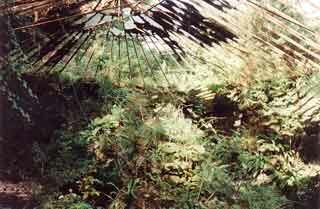
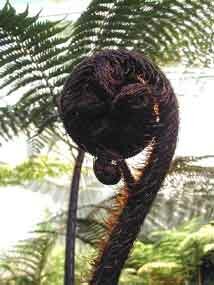
As to our second ruin, when the "jungle" was gradually cleared, we uncovered a large glazed structure in the undergrowth, almost hidden by a covering of ivy. Rustic steps led down to the sunken, dingy, interior full of broken glass, water, mud and brambles. This apart, it was a fascinating spectacle, with strangely fashioned walls as well as a clogged up pond full of rotting vegetation. Here and there could be seen fallen black fibrous "trunks", which was all that remained of the tree ferns that had once thrived in this magical place.
|
|
 |
|
| |
|
This as we later discovered, had once been a magnificent fernery housing many exotic sub-tropical ferns. However, with so much time, attention and money needing to be spent on the house, we never at that time seriously considered the fernery's restoration.
In the meantime, an article had come to light in The Gardeners Chronicle of 1879, which featured the fernery. This included not only a wonderful description of the place but also a complete inventory of the ferns - an invaluable record, should the fernery ever be restored.
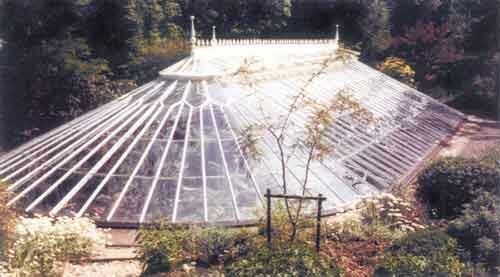
Over a period of time we had an ongoing dialogue with Historic Scotland, and in 1995 they awarded a substantial grant towards the restoration of a new roof for the fernery. A good architect was employed, the right blacksmith was found, and the crumbling iron spars from the original roof were carefully removed. A new roof, identical to the original, was erected and glazed in 1996.
|
|
| |
|
 © ©
|
|
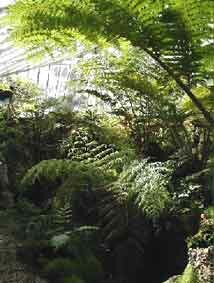
As far as the restocking with ferns was concerned, we realised this was going to be a huge undertaking, and we approached The Royal Botanic Garden, Edinburgh initially for advice. However, when Mr. David Mitchell of the R.B.G.E. first viewed the fernery, his reaction was one of delight, and an agreement was reached whereby the R.B.G.E.'s involvement would be comprehensive. Using the Gardeners' Chronicle as a guide, a new collection of pteridophytes (ferns) was planted in a style evocative of the original planting. The fernery opened to the public for the first time in June 1997.
Last year ( 2001 ) The Historic Gardens Foundation awarded First Prize to Ascog Hall Fernery for the restoration of a built structure in a historic park or garden. There were eleven entries in all throughout Scotland so winning such a prestigious prize was an honour indeed. The official presentation took place in the Trade Halls in Glasgow in July 2001 and the important event was well covered in the national press.
During the same year, the fernery was featured on television in BBC Gardeners' World and also The Beechgrove Garden
|
|
| |
Extract from Alistair Wardlaw's article in the Pteridologist, 1998
"Surely one of the most significant (and least publicised) pteridological events in Britain of the last two years was the opening of this restored Victorian fernery. It is a story of past love, neglect and decay, accidental discovery in a "jungle", and romantic and dedicated rebuilding and restocking. The place is Ascog Hall, the location is the Island of Bute, and the energetic restorers are Wallace and Katherine Fyfe who own the property.
|
| |
|
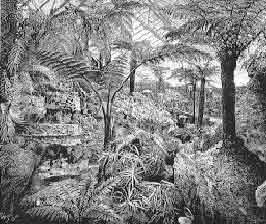
The story starts around 120 years ago and is reported in The Gardeners' Chronicle of October 25, 1879 when the fernery had recently been completed. This early article, illustrated with a woodcut showing tree-ferns, describes much of what the visitor sees again today.
When the Fyfes first stumbled on the ruined structure in 1987, they did not recognise its true nature. It was totally derelict, the roof having all but collapsed and the interior cavity like the basement of an ancient building, was choked with trees and brambles. Miraculously, one large fern had survived! A huge specimen of Todea Barbara, with a mountainous rhizome about a metre in diameter and 3 metres high, is still visible today. This very same fern was said to be "a thousand years old or more" in the Gardeners' Chronicle article.
|
|
 |
|
| |
|
The basic structure is an L-shaped canyon excavated in a natural bank, and with a span roof of iron girders and glass at ground level. Thus, one enters the structure by going down steps as if into a grotto. This semi-burial in the ground allows the fernery to be unheated and yet be suitable for a wide range of sub-tropical vegetation. Indeed in summer, there is often a problem of keeping it cool, even with all the vents open. The interior walls are of the local red sandstone, in blocks of menhir dimensions that are very sculptural and pleasing. At the far end is a small waterfall, which divides into a stream that meanders down the centre around a pool with an elongated island crammed with ferns. The whole interior has to be watered every day during the summer months.
Credits for the restoration must go to Historic Scotland for helping to fund the new roof, which would have been impossibly expensive for private owners, and to the Royal Botanic Garden, Edinburgh, for the restocking of the fernery. But the major credit must be reserved for Wallace & Kath Fyfe for their vision, initiative and sheer hard work to get the fernery restored and then to maintain it."
|
| |
 |
|
 © ©
|
|
| |
|
|
