|
|||||||||||
THE GARDENA visitor to Ascog Hall in 1986 could have been forgiven for thinking they had stumbled upon a scene reminiscent of a fairy tale where time had stood still for a great number of years, allowing a vast and impenetrable forest of brambles to have sprung up, obliterating everything. Old photographs revealed that the grounds had originally been planted with formal shrubberies, island beds and extensive lawns. Around 1870, Alexander Bannatyne Stewart owner of Ascog Hall, commissioned Edward La Trobe Bateman (1816-1897) to landscape the gardens. In 1867 Bateman had returned to Britain from Australia where he was renowned for his artistic pursuits, including book illustrations, architectural design, ornate stencilling and the laying out of ornamental grounds, which included a part of the Melbourne Botanic Gardens. Sadly none of Bateman's original plantings have survived, but we believe he formed the banks and established the new perspective which can still be seen and which add such a pleasing dimension, compared to the original completely flat topography. A great many trees such as self-seeded sycamores and ash needed to be felled before any serious attempts at gardening could begin. As what seemed like miles of ivy was pulled out, the original paths were revealed and also the remains of a concrete pond, damaged beyond repair by tree roots. |
|||||||||||
|
|||||||||||
|
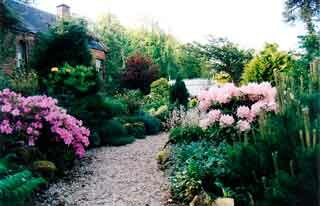
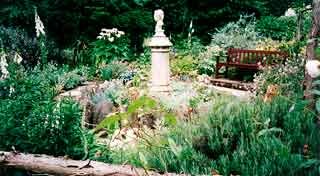
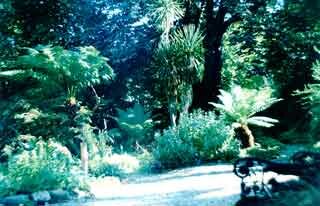
The garden, now although only having been replanted over the past ten years, looks remarkably established and, as the paths meander through undulating banks and beds, it gradually unfolds, revealing delightful surprises as one moves from one part to another. All the planting, weeding and maintenance is done by ourselves so ground cover is important. Nevertheless a wide variety of choice perennial plants and shrubs are grown, many of which cannot thrive further inland. Azaleas and primulas are at their best during May and June, as well as the wonderful blue poppies - meconopsis sheldonii. Irises, hostas and euphorbias herald the start of summer and in the new rose garden the old shrub roses, under planted with catmint, are not only a feast for the eyes at midsummer, but their wonderful seductive perfume tempts one to linger for a while. Behind the fernery and leading up to the house is an area devoted to plants with mainly white flowers, interspersed with the odd splash of purple, offering a restful change from the stronger colours which dominate other parts of the garden. A new gravel garden has just been formed in what once was a tennis court, and we are planning to restore the old pond soon. |
|||||||||||
|
|||||||||||
|
|
|||||||||||